

T-RECs
Thermal - Renewable Energy Credits
... a timely issue of equity & of efficacy ...

|
ASHP produces renewable energy
GSHP produces renewable energy
|
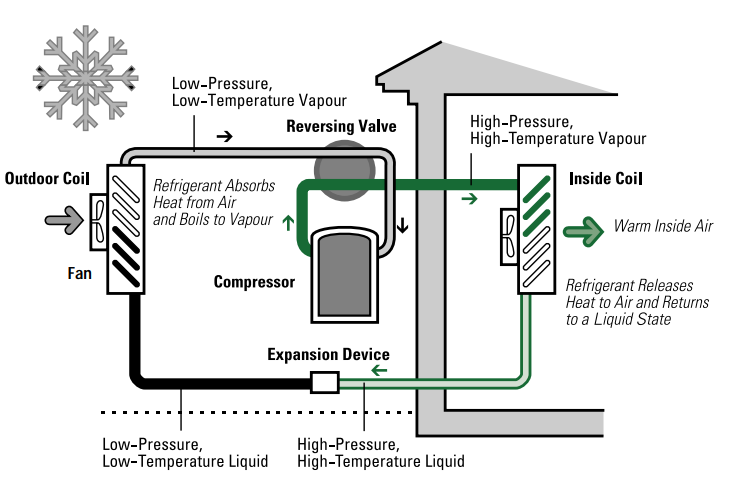
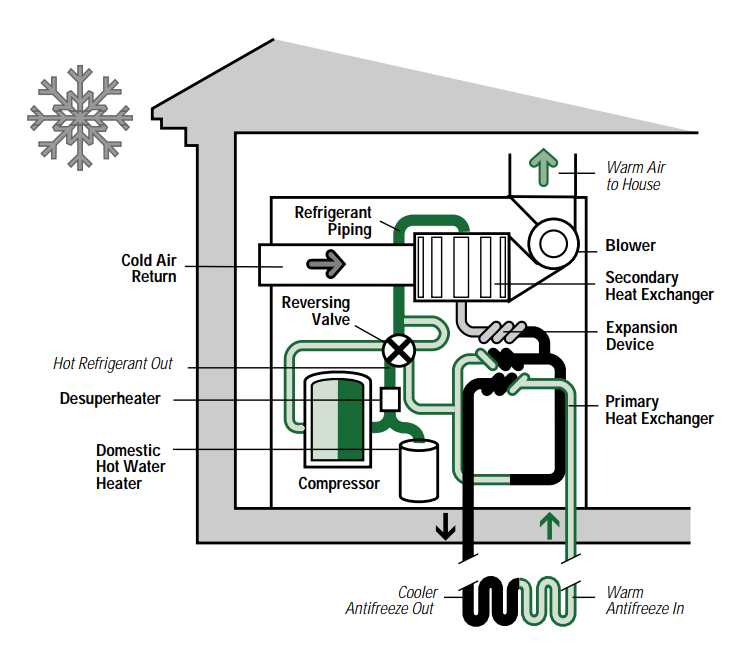
For many years, electric utilities have provided Renewable Energy Credits (RECs) to incent the generation of power from wind, solar and other renewable energy technologies. Regulators have no idea how the electricity will be used, so the goal is to reduce the combustion of fossil fuels by funding the "clean attributes" of renewable electricity.
In 2022, Canada generated 640 billion kWh of electricity, of which hydro produced 392 b-kWh, combustible fuels 123 b-kWh, nuclear 82 b-kWh, wind 39 b-kWh, solar 3 b-kWH, tidal 0 kWh. (source: Statistics Canada) There is no indication where a REC was provided, nor do the data quantify the GHG emitted from each source, although hydro, nuclear, wind & solar are assumed to have zero Scope 1 emissions. Electricity is not an end-use application; it is a carrier that transmits electrons from site of generation to a site where they are consumed in end-use consumption.
Canadians must understand your role in consuming energy & emitting carbon, and this site will focus only on the residential sector. It ignores the impacts of driving gasoline cars or flying airplanes or using products with high Scope 2 or Scope 3 emissions; its intent is to demonstrate how much of the climate problem is caused by your household. It converts PJ to kWh, Mt to kg, and m2 to ft2 so the measures are more easily understood by more people.
AN ISSUE OF EQUITY
If regulators provide a REC to encourage electricity from renewables, should a REC be offered to your home for adopting technologies for thermal end-use applications which produce renewable energy and emit no carbon?
NRCan data show that 15.3 million households in Canada (houses & apartments, total floorspace of 25 billion ft2) consumed 406 billion kWh of secondary energy in 2022, of which 328 billion kWh (81%) was for the three thermal applications of space heating, space cooling & water heating. All households emitted 56 billion kg of carbon, of which 48 billion kg (87%) was from thermal applications, or 3,149 kg for every dwelling.
The country's commercial / insitutional sector consumed 334 b-kWh, of which 220 b-kWh (67%) was for thermal applications. It emitted 48 b-kg, of which 36 b-kg (77%) was from thermal end use.
AN ISSUE OF EFFICACY
There are numerous methods to reduce energy consumption and to reduce carbon emissions, but everything starts with adherence to the Rule of 3C.
Once demand is minimized, many thermal supply technologies are classified as renewable, including solar water heating and biomass wood stoves (the latter emits carbon as it burns wood, and dead trees can no longer produce oxygen or sequester carbon). NRCan data show that residential reliance on natural gas & oil for thermal applications has remained fairly constant since 2000, while the use of electricity has increased, due partly to the increased sale of heat pumps which produce thermal renewable energy for space heating, space cooling & water heating.
Nationally, the average household (1,604 ft2 floorspace) consumes 26,401 kWh of secondary energy each year and emits 3,627 kg of carbon. Of this, thermal applications consume 21,306 kWh (13 kWh per ft2) and emit 3,149 kg of carbon (2 kg per ft2). Lights & appliances consume 5,094 kWh and emit 185 kg. Results will differ based on factors such as buildig insulation, location in Canada, age & efficiency of appliances, thermostat settings, number of occupants, carbon content of grid electricity, etc.
The output from an ASHP (Air Source Heat Pump) or GSHP (Ground Source Heat Pump) is renewable energy, and both systems require electricity to power their compressor, pumps, motors, etc. Their ratings for SEER (Seasonal Energy Efficency Ratio) or COP (Co-efficient of Performance) indicate how much power will be required to produce the renewable energy output and, if the unit has been installed properly, it could be one-quarter of the output, or 5,000 kWh a year.
A T-REC would incent this production of renewable energy under a range of scenarios which suit local conditions, and payments could reflect total or net production, reflect the utility's TOU factors, among others. A long-term incentive would encourage high levels of efficiency and would eliminate the up-pricing of installation which often accompanies a one-time grant or rebate.
Details are open to discussion ... what must be recognized immediately is that the output from a heat pump is renewable energy, that production can be quantified, and the thermal impact on energy & environment is equal or greater than the production of renewable electricity.
NetZeroPLUS Canada will promote this concept among the industry, regulators & politicians, and building occupants. We have produced a number of internet sites with further information:
|
Common Misperceptions of Ground Source Heat Pump NRCan: Heating & Cooling with a Heat Pump |